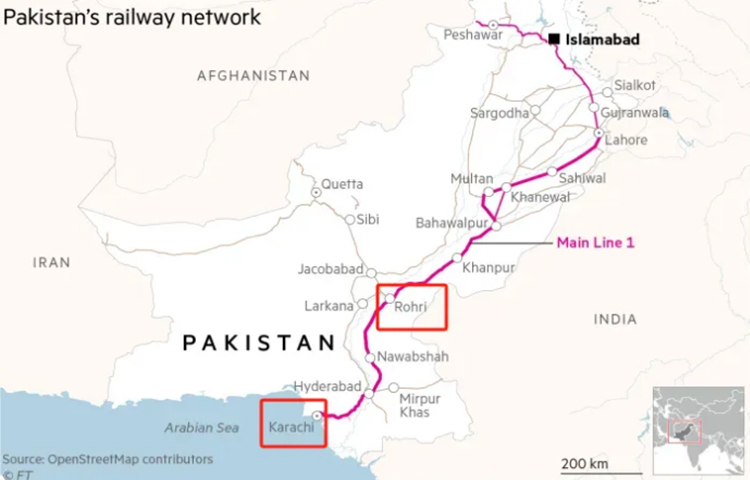
Pakistan’s Railways Minister Hanif Abbasi confirmed to Arab News this week that the country has secured Chinese approval to move forward with a $2 billion upgrade of the Karachi-Rohri railway line. Led by the Asian Development Bank (ADB), the financing will be supported by a consortium including the ADB and the Asian Infrastructure Investment Bank (AIIB), following an agreement with China. The project is part of the $60 billion China-Pakistan Economic Corridor (CPEC), an initiative under President Xi Jinping’s Belt and Road Initiative.
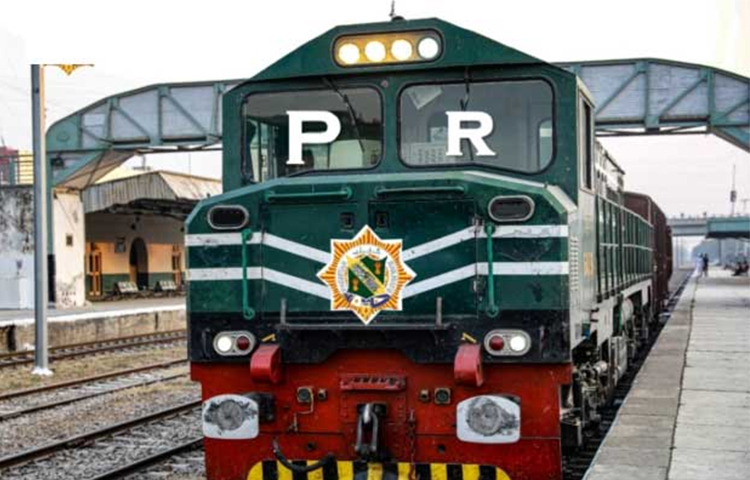
As a segment of the broader $7 billion Main Line-1 (ML-1) project, the Karachi-Rohri upgrade is of great significance. The ML-1 project aims to revamp Pakistan’s 1,726-kilometer colonial-era railway system connecting Karachi to Peshawar. Currently, the Karachi-Rohri section operates at a speed of only 40 km/h; after the upgrade, this will be increased to 120 km/h, significantly boosting transport efficiency.
Notably, the railway section is a key supporting facility for the Reko Diq mining project—a joint venture between Canada’s Barrick Gold and Pakistan, which is expected to generate billions of dollars in exports over the coming decades. The upgraded railway will focus on facilitating the transport of copper and gold ores. Abbasi emphasized that while funding comes from the ADB, China will oversee project execution due to its expertise in railway construction.
Abbasi added that Pakistan will seek Chinese approval for each section of the ML-1 project as alternative funding is secured. While the project’s financing terms are still under negotiation, the minister assured that interest rates will remain “low.” The project is set to break ground in mid-2026, with the ADB’s feasibility studies having been concluded in December 2023. Furthermore, the Reko Diq Mining Company (RDMC) has agreed to provide $390 million in bridge financing for the stretch between Rohri and Nokundi in Balochistan. Once upgraded, this section will transport up to one million tons of copper annually, replacing the need for 28,000 truckloads and cutting logistics costs.
Addressing security concerns in Balochistan—where separatists frequently target infrastructure—Abbasi pledged enhanced security measures, including the deployment of the Federal Constabulary, to protect mineral-carrying trains. Beyond the Karachi-Rohri upgrade, Abbasi announced plans to resume the Islamabad-Tehran-Istanbul (ITI) freight service in December, which was suspended in 2019. The service is expected to boost Pakistan’s exports of goods like rice and pink salt to Europe and Turkey. Additionally, Pakistan is advancing the proposed $10 billion Uzbekistan-Afghanistan-Pakistan (UAP) railway project, which will connect Termez (Uzbekistan) to Kabul and Pakistan’s Kurram district, potentially opening up access to European and Central Asian markets.

